Lash Extension Curl Types Explained (J, B, C, CC, D, L and More)
In this guide
Quick answer: Lash extension curls are labelled with letters from straightest to curliest: J → B → C → CC → D → U, with L/L+ for lashes that rise straight from the base and then lift. C is the everyday favourite, D is more dramatic, and L/L+ helps hooded, monolid or downturned eyes.
The curl letters are lash-industry conventions rather than a formal standard, and each brand's C or D varies a little. Use this guide to talk to your artist, together with our types of lash extensions overview.
Curl types at a glance
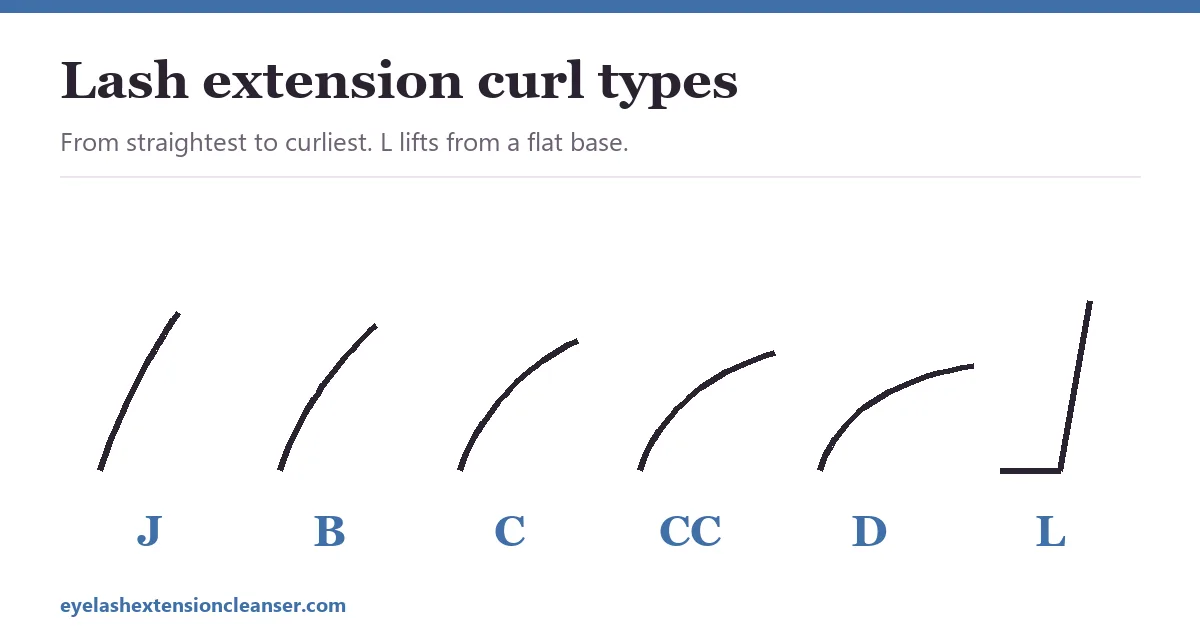
| Curl | Shape | Look | Often suits |
|---|---|---|---|
| J | Almost straight, slight bend at tip | Very natural | Straight natural lashes, subtle sets |
| B | Gentle curve | Natural lift | Natural looks, upturned eyes |
| C | Moderate curve | Popular, open | Most eye shapes |
| CC | Between C and D | More lift | Straight lashes that need help |
| D | Strong curve | Wide-eyed, dramatic | Deep-set or round eyes |
| U | Very tight curve | Doll-like | Dramatic styles (use with care) |
| L / L+ | Flat base, sharp lift | Strong lift without touching lid | Hooded eyes, monolids, downturned or straight lashes |
Choosing a curl for your eyes
- Hooded eyes: more lift (CC, D, L/L+) so the extensions clear the fold; moderate lengths (lash extensions for hooded eyes).
- Monolids: L or L+ lifts from a flat base without pushing into the lid.
- Deep-set eyes: C or D brings lashes forward and opens the eye.
- Downturned eyes: L or D on the outer third lifts the corners.
- Glasses wearers: less curl and shorter lengths so lashes don't touch the lenses (lash extensions with glasses).
- Straight, downward-pointing natural lashes: stronger curls or L curls hold better and look more even.
Curl works with style: the same curl can look natural in an open "natural" map or dramatic in a "cat eye" map. See lash extension styles.
Why matching curl to your natural lash matters
An extension that's much curlier than the natural lash it sits on has a small contact area with that lash. That can make the bond less secure and the result look uneven. Artists often pick a curl close to your natural curve or use L curls to correct downward-growing lashes.
Weight and length matter too. EyeWiki describes natural lash loss from the weight of synthetic lashes as a known complication (EyeWiki). More in do lash extensions damage natural lashes?
Curl choice matters most for lids with little visible crease; see lash extensions for monolid eyes. Coloured fibres come in most curls too: colored lash extensions.
Can you curl lash extensions?
Avoid lash curlers. Heat and pressure can crimp or break synthetic fibres and stress the bonds, and tugging can harm natural lashes — the American Academy of Ophthalmology warns that rubbing, tugging or pulling can break natural lashes and damage follicles (AAO). If the curl has dropped, it's usually because lashes have grown out; brushing them and a fill will bring the shape back.
Key takeaways: J and B are natural, C is the all-rounder, D is dramatic and L/L+ lift hooded or straight lashes. Match curl to your eye shape and natural lashes, keep lengths sensible, and don't use a curler on extensions.
Frequently asked questions
What is the most natural lash extension curl?
J and B curls are the most natural because they mimic straight or gently curved natural lashes. C curl is the most popular everyday curl - noticeable but still natural.
What is the difference between C and D curl lashes?
D curl is curlier than C. It opens the eye more and looks more dramatic; C curl is softer and suits most people.
Which lash curl is best for hooded eyes?
Curls with more lift, such as CC, D or L/L+, help extensions clear a hooded lid. Your artist will also keep lengths moderate so lashes don't touch the brow bone.
Can I use a lash curler on extensions?
It's best not to. Curlers can crimp, bend or snap extensions and stress the bonds. If you want more curl, ask for a stronger curl at your next fill.
Is the same curl letter the same across brands?
Not exactly. Curl letters are industry conventions, and each manufacturer's C or D can differ slightly.
Sources
- Eyelash Extension Facts and Safety — American Academy of Ophthalmology
- Eyelash Extensions (EyeWiki) — American Academy of Ophthalmology